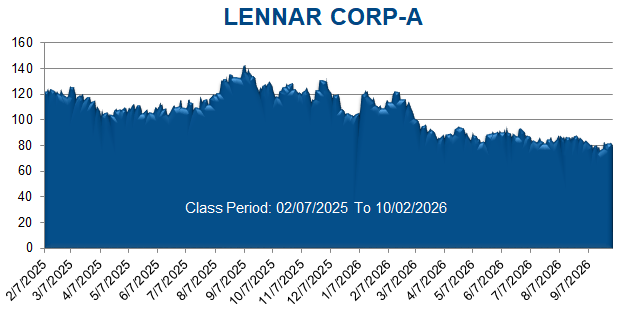
A securities class action has been filed against Lennar Corporation (LEN) on behalf of all purchasers of Lennar common stock during the period between February 7, 2025 through October 2, 2026. This case has been filed in the USDC – SDFL.
Lennar is one of the nation’s leading homebuilders. Since 2013, Lennar has been shifting its focus from on-balance sheet ownership and associated debt to land option platforms and option agreements. Lennar described this change as a shift to an “asset-light, land-light” strategy focused on building homes rather than holding land. As part of this ongoing strategy, Lennar increased its use of off-balance sheet vehicles to acquire homesites.
Lennar reported fiscal third-quarter deliveries of 20,840 homes, above the 20,500 it initially forecast, at a time when the housing market was weakening. A report found that Millrose Properties bought hundreds of Lennar homes in the final week of that quarter, and that without those purchases Lennar’s deliveries may have fallen below its target. Lennar spun off Millrose in 2025, and Lennar’s CEO reportedly holds significant voting power over it.
On this news, Lennar’s stock price fell $2.30 per share, or 2.80%, to close at $79.81 per share on October 2, 2026.
The complaint alleges that throughout the Class Period, Lennar touted (i) a simplified operating strategy that the Company claimed would effectively counter challenging market forces, and (ii) the Millrose spin-off as a successful strategic action that was solely used to accelerate its asset- and land-light positioning. Both categories of statements were false. First, Lennar employed an undisclosed scheme whereby expenses associated with Lennar’s option agreements with land banks were capitalized—rather than listed as expenses on the balance sheet—in order to give a misleadingly favorable short-term impression of demand and financial performance. Second, Lennar hid the fact that Millrose had abandoned its stated mission as a land bank and was in fact purchasing Lennar homes at above market rates, and renting them at below market rates, to further inflate the Company’s earnings and cover up declining demand for its homes. Both sets of misstatements and omissions gave a false and misleading picture of Lennar’s business and financial prospects.