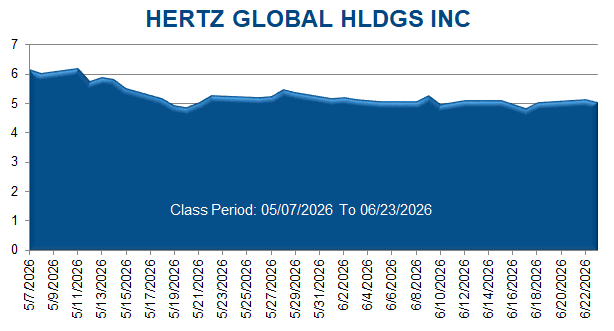
A securities class action has been filed against Hertz Global Holdings, Inc. (HTZ) on behalf of purchasers of Hertz common stock between May 7, 2026 through June 23, 2026. This case has been filed in the USDC – MDFL.
Hertz is one of the largest vehicle rental companies in the world, renting cars and light trucks under the Hertz, Dollar, Thrifty, and Firefly brands at more than 11,000 locations in roughly 160 countries. The economics of the business turn on the fleet: Hertz buys hundreds of thousands of vehicles, finances most of them through asset-backed securitizations, and depends on reselling them into the used-car market at prices that hold up. Residual values and depreciation per unit are therefore central to whether the Company is profitable. After emerging from bankruptcy in 2021 and taking large write-downs on an ill-timed bet on electric vehicles, management launched a “Back-to-Basics” turnaround built around fleet discipline and cost control.
The Class Period begins on May 7, 2026, when Hertz announced its first quarter 2026 results, touting its “Strongest Revenue Growth in Three Years,” a 13% year-over-year improvement in Net Depreciation per Unit per Month to $312, and approximately $837 million of liquidity supplemented by roughly $200 million from an April financing. On that day’s earnings call, Hertz’s Chief Financial Officer told investors that the Company expected to end the second quarter with just under $1 billion of liquidity and to end the year “north of $1.5 billion.” The following day, Hertz filed its Form 10-Q, which stated that the Company’s cash, liquidity facilities, and refinancing options would be sufficient to fund its operating activities and obligations for the next twelve months and for the foreseeable future thereafter.
According to the complaint, those statements were materially false and misleading because: (i) Hertz’s liquidity was deteriorating far more rapidly than represented, and the Company’s available liquidity was not sufficient to fund its operations and obligations for the next twelve months without resorting to a distressed, dilutive financing; (ii) the softness in the used-car market that defendants had characterized as isolated to the quarter and transitory had in fact recurred and was materially depressing the Company’s net depreciation per unit and Adjusted Corporate EBITDA; and (iii) as a result, Hertz was likely to undertake a dilutive, distressed capital raise that would materially harm existing shareholders.
On June 24, 2026, before the market opened — just weeks after assuring investors that its liquidity would carry the Company for at least twelve months — Hertz announced that a wholly owned indirect subsidiary intended to offer $300 million of Exchangeable Senior First-Lien Secured PIK Notes due 2030, together with a concurrent share-lending offering of more than 37 million shares of common stock from which the Company would receive no proceeds. Hertz simultaneously disclosed that “unexpected softness in the used car market” had caused losses on the sale of vehicles in May 2026 and would drive second quarter Adjusted Corporate EBITDA down to a range of just $50 million to $80 million.
On this news, the price of Hertz common stock declined more than 40%, closing at $3.00 per share on June 24, 2026. The next day, the offering priced on still more dilutive terms — upsized to $350 million (up to $400 million) at a 6.75% coupon, with an exchange price of approximately $3.58 per share, and with the borrowed common stock sold to the public at just $2.70 per share.