A securities class action has been filed against Microsoft Corporation (MSFT) common stock between May 1, 2025 through January 28, 2026. This case has been filed in the USDC – WDWA.
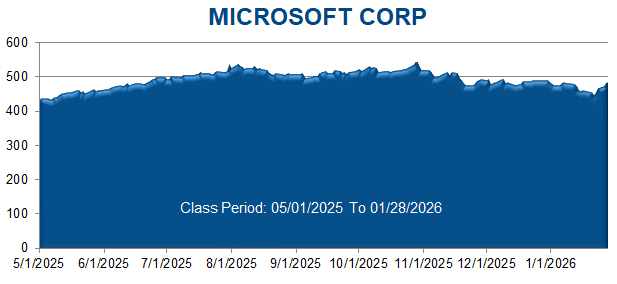
Microsoft is one of the largest technology conglomerates in the world.
The Microsoft class action lawsuit alleges that defendants during the Class Period made false and/or misleading statements because they failed to disclose that: (i) Microsoft’s Copilot family of products had experienced significant brand positioning, user experience, usage, data siloing, computational capacity, organizational, and interoperability problems; (ii) Microsoft’s flagship proprietary AI model ranked well below competitors on a number of benchmark tests; (iii) Microsoft needed to increase by billions of dollars its capital expenditures and divert graphics processing unit (“GPU”) and central processing unit (“CPU”) capacity away from fulfilling demand for its profitable Azure services in order to improve the competitive positioning of its critical Copilot family of products and increase its AI-related research and development (“R&D”); and (iv) as a result of the above, Microsoft had failed to convert a significant percentage of its commercial Microsoft 365 users to paid Copilot subscriptions and Microsoft’s Copilot offerings had lost market share to rival products, a trend that was increasing.
On January 28, 2026, Microsoft announced disappointing results for its fiscal second quarter ended December 31, 2025. First, during the quarter Microsoft’s Azure growth had slowed suddenly and fallen below analyst expectations. During the related earnings call, CFO Amy E. Hood revealed that the slower Azure growth was primarily due to computational capacity constraints, as Microsoft had diverted CPU and GPU capacity to Copilot applications and AI-related R&D. Second, Microsoft revealed that its capital expenditures had increased to $37.5 billion during the quarter, causing Microsoft’s capital expenditures for the first six months of its fiscal 2026 to increase to $72.4 billion compared to $88.2 billion for all of Microsoft’s fiscal 2025. Third, Microsoft revealed, for the first time, that the number of paid Microsoft 365 Copilot seats totaled only 15 million to date, materially below analyst estimates and a fraction of the more than 450 million commercial Microsoft 365 users. On this news, the price of Microsoft stock fell nearly 10%.
Then, on February 3, 2026, The Wall Street Journal revealed, in an article titled “Microsoft’s Pivotal AI Product Is Running Into Big Problems,” that severe challenges and functionality issues had plagued Microsoft’s Copilot offerings, leading to Copilot losing market share during the Class Period to competing products such as Google’s Gemini. The price of Microsoft stock continued to fall in the days after Microsoft’s second quarter 2026 earnings announcement as the market continued to digest the adverse news and sources such as The Wall Street Journal revealed new adverse information.
Thereafter, on March 17, 2026, The Wall Street Journal revealed in an article titled “Microsoft Seeks More Coherence in AI Efforts With Copilot Reorganization” that Microsoft was reorganizing its Copilot product teams to unify commercial and consumer versions partly in response to the challenges revealed by The Wall Street Journal’s prior reporting on Copilot’s problem-plagued development and disappointing customer adoption. On this news, the price of Microsoft stock continued to fall.